Drinking Apple Cider Vinegar (ACV) cannot cure gallstones. It is a myth that has been propagated online. There is no scientific evidence that backs the claim that drinking apple cider vinegar can cure gallstones. But what about the people who have benefited from their gallstones by drinking apple cider vinegar?
Well, if we consider they’re not lying, it may be that their gallstones were small enough that they could be treated without surgical intervention. It must be noted that surgical intervention is the only long-term treatment option for gallstones. Otherwise, you leave yourself open to the risk of gallbladder cancer.
So, let’s debunk the myth surrounding apple cider vinegar curing gallstones in detail. We’ll also be discussing the actual treatment options for gallstones that are proven to work.
Can drinking apple cider vinegar cure gallstones?
No, drinking apple cider vinegar cannot cure gallstones.
It is a medical myth.
The reason this myth is popular is because people are afraid of surgery. Natural remedies are cures are easier and give people hope that their ailments can be cured by something that’s lying in their cabinets. So, unfortunately, drinking apple cider vinegar doesn’t cure gallstones.
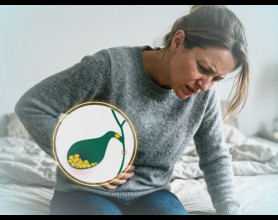
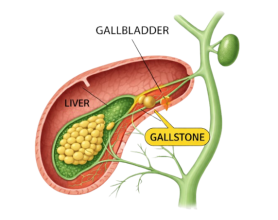
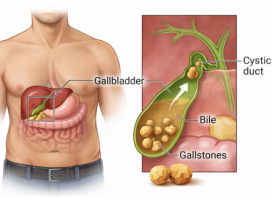
Gallstones are stones that form inside your gallbladder. They are generally pieces of hardened bile that form inside the gallbladder because of underlying lifestyle and dietary habits. Generally, gallbladder stones form because of excess levels of cholesterol in your bile.
This causes your bile to thicken, which makes it more prone to crystallise. Also, in people with gallstones, it is often found that their gallbladder doesn’t empty properly. All these factors combined become the cause of gallstones.
Since we’ll be talking about the treatment options of gallstones, it is important to note the types of gallstones. There are primarily two types of gallstones.
Gallstones are often asymptomatic and only identified during routine scans. Gallstones become symptomatic when they start blocking your bile duct or if they get stuck in any part of your bile duct. The common symptoms of gallstones are mentioned below.
The symptoms mentioned above are common in cases of gallstones, irrespective of the type of gallstones. The sudden upper right abdominal pain is common in cases when the affected person has a fatty meal. This is when the gallbladder has to contract to release bile, but the presence of the stone makes the contraction trigger pain.
The claims around why apple cider vinegar is claimed to work often revolve around the notion that the acetic acid in vinegar can dissolve gallstones. This is not true and not how science works. The myth is propagated by a very simplified explanation of science and reinforced when people share personal stories. The personal stories taken are proof that the system works, and it is popularised on blogs, social media, and online forums.
Here are the top reasons this myth is popular:
There is no scientific evidence to suggest that ACV can dissolve gallstones. There have been no clinical trials or peer-reviewed studies supporting this claim. There’s actually a very good reason why the logic is entirely flawed, and the idea doesn’t work. Let’s look at it scientifically.
When you eat food, it goes inside your body through your mouth, it reaches your stomach through your food pipe, and then it goes to your excretory system through the small and large intestines before going out of your body as either stool or urine.
Did you notice at any of these steps that food reaches the gallbladder directly? No, you didn’t because food doesn’t reach the gallbladder.
So, ACV has no way to get to the gallbladder to dissolve the stones. The action of dissolving stones requires direct contact with the stones, right? That’s physically impossible, as you can imagine. Do you know what happens when you do, in fact, have ACV?
When you drink ACV, it enters the stomach, where it is diluted and processed. It is then neutralised during the digestion process and absorbed into the bloodstream. It never reaches the gallbladder in a strong enough form to dissolve the gallstones in any meaningful manner.
Gallstones are formed due to years of lifestyle and dietary habits, as well as underlying health conditions. It cannot be treated by simply adding acid to your diet. There’s complex bile chemistry at play here.
Adding ACV to your diet has both benefits and risks. The benefits don’t have any relation to gallstones. However, as you have heard online many times, ACV does have some health benefits. Additionally, there are also real risks associated with ACV consumption. Let’s review both.
There is limited evidence on the benefits of ACV, but there’s still some evidence that suggests:
There are several treatment options for gallstones. While surgical treatment is the gold standard due to its long-term relief and safety, there are other non-surgical treatment options too. In fact, in some cases, no treatment may be required at all. So, let’s review all the treatment options for gallstones.
If gallstones are identified in a routine scan and are asymptomatic, doctors do not recommend any treatment. They may recommend planned surgery in the future, but unless the gallstones start acting up, they may not recommend surgery or any other treatment for that matter. Doctors will continue to wait and monitor the gallstones to ensure it is not harming you in any way. Lastly, in such cases, doctors may recommend dietary and lifestyle changes to reduce the risk of the stones further growing or increasing in number.
There are certain medications that can help dissolve gallstones. But they work in very specific cases and take up to a year to actually dissolve the stones. If the treatment stops, the stones may return. Additionally, these medicines are used selectively and not recommended as a first-line solution. Among the medicinal options, ursodeoxycholic acid is commonly used to help dissolve small cholesterol-based gallstones.
This is the gold standard for gallstone removal as it also eliminates the risk of gallstone recurrence and gallbladder cancer. The surgery is also very safe, and today it can be completed in less than five minutes at specialised medical institutions like the MASSH Super Speciality Hospital in Delhi. The low surgery time ensures patients are under the effects of anaesthesia for a short period. This aids in quicker recovery time, with patients being able to go back home within a few hours of the surgery.
Surgical removal of gallstones is performed using a surgical procedure called cholecystectomy. The surgery is performed as a minimally invasive procedure that involves making small incisions in the body and inserting a camera scope inside the surgical field to visualise and perform the surgery. In a cholecystectomy, the gallbladder is removed from the body along with the gallstones. At the MASSH Super Speciality Hospital, a specialised visualisation technology called 3D visualisation is utilised to make the surgery quicker, safer, and allow faster recovery for patients. Overall, this surgery is among the safest surgeries in the world currently, and thousands of surgeries are performed every day with little to no surgical complications arising.
As it is with any surgery, the surgical risks include infection of the surgical site after the surgery. This is why it is very important to maintain excellent hygiene and follow all your surgeon's instructions after the surgery. It prevents infections and other postsurgical risks. For more information about 3D laparoscopic cholecystectomy, consult with our specialists at the MASSH Super Speciality Hospital.
There are two other procedures that are used to remove the gallbladder and gallstones.
With this article, you can finally put the myth to rest: drinking apple cider vinegar does not help you cure gallstones. What does help is getting medical attention if you’re in pain. Gallstones that are symptomatic are causing blockages in your gallbladder or the biliary tract. If you don’t get them treated, it can negatively affect your health.
This is why it is important to get medical attention quickly, as it can help you prevent complications. For further information about gallstone treatment, feel free to consult with our specialists at the MASSH Super Specialty Hospital. We’re available 24/7 to help you with both scheduled and emergency surgical treatment for gallstones.
MASSH Super Speciality Hospital Gastroenterology Team
Our highly experienced gastroenterologists have expertise in advanced treatment options for gallstones, including specialised minimally invasive surgical treatments like 3D laparoscopic surgery and ERCP. Treatments are often accompanied by lifestyle and metabolic guidelines for long-term, sustainable gastroenterological health.
No, apple cider vinegar cannot dissolve gallstones naturally. This is because apple cider vinegar that you consume orally does not reach the gallbladder with any potency to actually dissolve the gallstones. When you consume apple cider vinegar, it gets neutralised in the digestive process, and any nutrients in it are transported through the bloodstream.
There are certain medications that can allow gallstones to dissolve, but the process takes up to one year, and it is not recommended as the first course of treatment. In most cases, doctors will recommend scheduled gallbladder removal surgery to reduce the risk of gallstones worsening, recurring, or even gallbladder cancer. In case you have symptoms, doctors will recommend emergency surgery in most cases.
No, diet alone cannot remove gallstones. Dietary habits can help you reduce your risk of gallstone recurrence and even stop gallstones from worsening. It can also help you prevent the symptoms of gallstones. But existing gallstones cannot be removed definitively. This is because gallstones take years to form and are caused by complex biliary chemistry. Diet alone without medications cannot aid in breaking down the stones.
Yes, gallbladder removal is safe. The surgery is one of the safest surgeries available in the world. As for removing the gallbladder from the body, your body can learn to adapt to live without a gallbladder. It changes the path of bile secretion, and patients can live a completely normal life even without a gallbladder. Certain dietary restrictions must be followed throughout their lives, but apart from that, there are no major risks associated with gallbladder removal.
If gallstones are left untreated, they can cause blockages in your biliary tract or gallbladder and cause immense pain. If you’re somehow able to manage the pain, which you actually can’t, the other complications that’ll arise include a risk of jaundice and liver dysfunction. Additionally, you’ll be putting yourself at a significantly higher risk of gallbladder cancer, which can be fatal.
No, lemon juice or olive oil, much like apple cider vinegar, cannot flush out gallstones. There’s another important thing to note here. Gallstones cannot be flushed out of the body like kidney stones. The kidneys are connected to an exit from the body through the urinary tract. This allows kidney stones to be flushed out. The gallbladder has no such connections. Gallstones can only be dissolved in some cases, but apart from that, there is no way to flush out gallstones with neither lemon juice, olive oil, or anything.
This blog is intended for educational and informational purposes only. It should not be considered a substitute for professional medical advice, diagnosis, or treatment. Always consult a qualified gastroenterologist in Delhi for proper evaluation and treatment recommendations.
It is important to know the differences in symptoms. Otherwise, it could lead to delayed diagnosis and a higher risk of complications arising fro...
Written by MASSH
Jul 23, 2026
Read about gall stone causes, symptoms, and treatment options in Noida including minimally invasive surgery for effective and safe removal.
Written by MASSH
Mar 26, 2026
Get trusted gallstone specialists in Ludhiana. Learn about symptoms, causes, and minimally invasive treatment options for safe and effective gall...
Written by MASSH
Mar 16, 2026



 Quick Enquiry
  Call(24*7)