Abdominal pain is a common health concern. It affects people of all ages, and it is generally not taken seriously in a medical sense. In men, abdominal pain and discomfort are often regarded as digestive distress or gastrointestinal problems. In women, alongside the mentioned problems, menstrual conditions are also attributed as the cause of abdominal pain. However, some abdominal pain can be indicative of underlying medical conditions rather than simple lifestyle-based symptoms.
Appendicitis is a serious medical condition that causes your appendix to swell and cause severe abdominal pain. If the pain is not taken seriously, it can cause grave medical complications, which can even lead to death. Even though appendicitis is also not a matter of grave concern for patients medically, since treatment is readily and easily available, timely diagnosis still matters. So, you must know where appendix pain can occur, what other symptoms it may bring on, and when you should go to a doctor with those symptoms. Remember not to panic but rather stay calm and monitor your symptoms as much as possible to get the best diagnosis at the earliest.
To understand where appendix pain is located, you’ll have to get into your physical anatomy and understand where the appendix is located. In medical terms, the appendix is said to be located at McBurney’s point. Now, unless you’re a doctor yourself, that wouldn’t make much sense to you. So, the easier, or rather more understandable, location of the appendix is that it is located in the right lower quadrant of your abdomen. In even simpler terms, it is located on the lower right side of your abdomen.
Now that you know where your appendix is located, let’s burst your bubble a little bit. The pain associated with appendicitis doesn’t always start at the appendix. It starts near your belly button. Then the pain moves from there in a characteristic way towards your appendix. All the while, your appendix or the area around it is visibly inflamed, and it is tender to the touch. The area that doctors use to determine appendix inflammation and tenderness is the McBurney’s point. If it all sounds too convoluted at the moment, let’s simplify it.
So, first things first, appendix pain doesn’t necessarily start where your appendix is located. It starts near your belly button or navel. As reported by patients, the pain often starts as a dull ache around the belly button. It is difficult to pinpoint the location of the pain or its underlying cause because pain around the belly button is often commonly caused by gastric upset, indigestion, or stomach problems. This is primarily the reason appendicitis is rarely identified at this early stage.
However, unlike pain associated with indigestion, pain related to appendicitis doesn’t subside over time. It increases, and it moves to the lower right side of your abdomen (where your appendix is). The inflammation progresses as well, and the area becomes even more tender and painful to the touch. The moving pain becomes sharper and more consistent. The pain also worsens with movement, coughing, or walking. It can become unbearable slowly.
The movement of the pain is what doctors use to identify acute appendicitis. This is one of the primary symptoms of the condition and allows doctors to start treatment protocols. It should be noted that even though medicinal treatment is available to help patients manage the pain, in the case of appendicitis, surgical removal of the appendix is the only way to get long-term pain relief.
Yes, appendix pain can present itself in some other places; in such cases, it is known as referred pain. The pain is generally contained in the lower right abdominal region; however, here are some other places where the pain can manifest.
Abdominal pain that’s caused by gas, indigestion, or stomach problems subsides with time and with the help of OTC medication. However, stomach pain that becomes persistent or worsens with time should always be reported to your doctor and evaluated carefully. Self-diagnosis is strongly discouraged in such situations.
| Stage | Pain Location | Pain Type |
| Early | Around the belly button (navel) | Dull, vague ache |
| Later | Lower right side of the abdomen | Sharp, constant pain |
| Advanced | May spread across the abdomen, especially if the appendix ruptures | Severe, intense pain requiring emergency care |
Just abdominal pain may not be enough to detect or suspect appendicitis. So, you must monitor and check for other symptoms. Do other symptoms present when you have appendicitis? Yes. Other symptoms generally accompany the pain. This makes it easier to connect the dots and understand whether you’re in need of emergency medical care or not. Here is a detailed look at the other symptoms that often accompany appendix pain.
Knowing and identifying the accompanying symptoms of appendicitis can help you reduce the risk of medical complications, and it can also help you get appropriate treatment and diagnosis in a timely manner. While not all symptoms will appear in the same manner for every patient, it is important to be vigilant and monitor your health when sudden abdominal pain or other symptoms start.
In short, the pain is often described as a dull ache in its initial stages. However, as the pain grows, it is described as sharp and intense. This is the short version; we’ll go into great detail about how the pain is experienced by patients.
But first, you must know that one of the best ways to differentiate appendicitis pain from general abdominal pain is that it doesn’t get better with time. In fact, quite the opposite, it worsens with time as your abdominal inflammation also increases. The pain is also experienced differently by different patients, so the accounts mentioned below are to help you get an idea; you may not experience the pain and symptoms exactly as described.
As mentioned previously, the pain associated with appendicitis often starts as a dull ache around your belly button. The dull ache is often characterised as a vague discomfort, also by many with a higher pain tolerance. At this stage, the pain is often misunderstood as gas, indigestion, or a stomach bug. However, if you’re having this pain, please try to check for the other symptoms discussed above to get a clearer picture of your health.
This is the step where the pain’s similarity with gas, indigestion, and stomach bug ends. Pain caused by lifestyle problems or dietary factors improves upon passing gas or with the help of OTC medication. However, for appendicitis, the pain only worsens with time, as does the inflammation around the area where your appendix is located. The pain also starts shifting at this point and becomes sharper and harder to ignore. This is the point where, regardless of whether you have other symptoms or not, you should consider visiting your doctor to understand the underlying cause of your stomach pain.
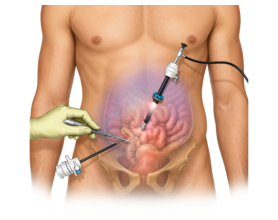
In the previous stage, if you’re lucky, the pain may act up when you’re coughing, moving, or walking. However, at this stage, the pain becomes more constant regardless of whether you move or not. The pain also becomes sharper and more intense, and directly shifts to the lower right abdominal region where your appendix is located. At this point, doctors can generally diagnose that the pain is caused by appendicitis just by the location of the pain and the tenderness of the skin in that area. You should definitely not delay treatment at this point and prepare for minimally invasive surgical treatment for appendicitis. That’s the only long-term and safest treatment option for appendicitis.
Even though appendicitis is not seen as a life-threatening condition, rupture of your appendix is considered a life-threatening complication. Without timely diagnosis and treatment, it is possible that the rupture of your appendix can lead to a condition called peritonitis, which gives patients only up to 72 hours at maximum to get emergency treatment before the condition becomes lethal and causes the patient’s death. When you experience appendicitis pain with other symptoms, this is why it is very important to take the pain seriously and seek appropriate medical care.
Here’s a clear table for you to understand and differentiate between the abdominal pain caused by different medical conditions. It will help you identify your early symptoms and get the medical treatment you need in a timely manner.
| Condition | Typical Pain Location | How it Differs from Appendix Pain |
| Appendicitis | Starts near the belly button and moves down to the lower right side of the abdomen. | Pain worsens steadily over time as the abdominal inflammation and tenderness increase. |
| Gas Pain | Can occur anywhere in the abdomen | Does not progressively worsen. In fact, the pain generally goes away after passing gas, taking OTC medication, or having a bowel movement. |
| Kidney Stones | Lower back or flank of the body. | Severe pain that comes in waves. The pain may also be accompanied by other urological symptoms. |
| Gallstones | Upper right abdomen in men and right shoulder or back in women (referred pain) | The pain is often triggered when you’re having a fat-rich meal. The pain is also not continuous in the case of gallstones. |
| Food Poisoning | General abdominal pain or cramping | Commonly linked with other digestive symptoms like diarrhoea, vomiting, and nausea. |
| Muscle Strain | Localised injury that affects specific abdominal muscles | Pain is caused after direct injury or specific physical activity. The pain only worsens when that muscle is strained again. |
To answer very briefly, the rule of thumb you should follow is to monitor the pain for a few hours and see whether it is reducing or not. If the pain worsens or if taking OTC medication for gas or indigestion doesn’t help relieve the pain, you should consider visiting a doctor.
Tolerating the pain and seeing how much worse it can get wins you no prizes. Early medical intervention can help you undergo a safer surgery and also prevent a world of pain and other symptoms that are associated with appendicitis. That being said, here’s a detailed version of what was just mentioned above.
As mentioned before, do not wait until the pain becomes unbearable to go to the doctor. An early diagnosis is the best way to treat appendicitis and prevent any of its complications.
Appendix pain is no joke, and it is relatively preventable if you are willing to be mindful of your symptoms and go to the doctor at the right time. The cause of appendicitis is not clearly known, but regardless of the underlying cause, there are established treatment protocols for appendicitis that can be used to treat cases of appendicitis. If you get a diagnosis at an early stage, you can treat appendicitis with planned surgery.
However, if you wait for the condition to complicate, it could lead to requiring emergency surgery. So, if you’re experiencing symptoms of appendicitis, be sure to visit a trustworthy medical institution like MASSH to learn more about your treatment options and get the best minimally invasive surgical treatments. Book a consultation with our specialists today to learn more.
MASSH Super Speciality Hospital Gastroenterology Team
Our highly experienced gastroenterologists have expertise in advanced treatment options for appendicitis, including specialised minimally invasive surgical treatments like appendectomy. Treatments are often accompanied by lifestyle and metabolic guidelines for long-term, sustainable gastroenterological health.
Yes, it is possible for appendix pain to come and go; however, this is a rare occurrence, and it relates to a different appendix problem known as chronic appendicitis. The condition that causes constant dull pain that worsens over time is called acute appendicitis, and it is more common than chronic appendicitis.
Yes, in its early stages, when the pain is near your navel, the pain can be mistaken for gas because it is dull. However, if the pain does not subside with time and rather worsens over time, it becomes clear that the underlying cause for the pain is not gas or digestive problems.
Yes, appendix pain always occurs on the right side because that’s where the appendix is located in your body. In some people, the appendix is located in other areas, like behind the large intestine or near the pelvis, so in those people, the appendix pain can appear in the areas according to the position of the appendix. However, in most cases, appendix pain always occurs on the right side.
Yes, you can walk with appendicitis. However, the pain may worsen due to movement, and the pain may make it difficult for you to move freely. This is why it is important to get immediate medical help if your pain is worsening and affecting your ability to move.
Appendicitis is not always an emergency if you’re identifying the symptoms in a timely manner and reporting them to your doctor. This way, you can prevent complications like peritonitis or sepsis, both of which can be life-threatening medical emergencies. The key lies in timely diagnosis and treatment to prevent appendicitis from becoming a medical emergency.
It is not advisable to wait before seeing a doctor if you are having serious abdominal pain that’s moving towards the lower right side of your abdomen. Waiting in these situations can only cause the pain to worsen and for other symptoms to start appearing like nausea, lack of appetite, vomiting, low-grade fever, and difficulty moving.
This blog is intended for educational and informational purposes only. It should not be considered a substitute for professional medical advice, diagnosis, or treatment. Always consult a qualified gastroenterologist in Delhi for proper evaluation and treatment recommendations.
Learn whether laparoscopic surgery is truly safe, its benefits, risks, recovery process, and why many patients prefer this minimally invasive tre...
Written by MASSH
May 16, 2026
A step-by-step guide to what patients can expect on the day of laparoscopic surgery at MASSH, Delhi, ensuring safety, comfort, and faster recover...
Written by MASSH
Jan 14, 2026
Experience advanced minimal access surgery at MASSH, South Delhi, with expert doctors, modern technology, and quicker healing.
Written by MASSH
Jan 12, 2026






 Quick Enquiry
  Call(24*7)